

Pipe floats are widely used to support floating pipelines in dredging, mining, marine construction, and water transfer projects. Since these systems often operate in rivers, lakes, coastal waters, and other demanding environments, every component must be built to withstand continuous exposure to water, impact, sunlight, and changing weather conditions.
While the material used to manufacture pipe floats is important, the production process is just as critical. In fact, the manufacturing method has a direct influence on the float's durability, structural strength, and service life. This is one of the reasons why rotational molding has become the industry standard for producing high-quality pipe floats.
A Seamless Design Makes a Real Difference
Unlike some manufacturing methods that require welded joints or bonded sections, rotational molding produces the entire float as a single, seamless piece. Eliminating joints means eliminating many of the weak points where cracks or leaks are most likely to develop over time.
This becomes especially important on active dredging or mining sites, where floating pipelines are constantly moving with currents, waves, and equipment operation. A seamless structure simply holds up better under repeated mechanical stress.
Many contractors prefer rotationally molded pipe floats for long-term projects because the one-piece construction provides greater confidence in demanding working conditions.
Even Wall Thickness Means More Consistent Performance
Another advantage of rotational molding is the way the plastic material is distributed during production. As the mold slowly rotates while heating, the polyethylene coats the inner surface evenly, creating a uniform wall thickness throughout the product.
This balanced construction helps the float absorb external impacts without creating localized stress points. It also contributes to more stable buoyancy, which is essential for keeping floating pipelines properly supported over long operating periods.
In practical applications, consistency matters. A pipe float that performs the same way year after year can significantly reduce maintenance concerns on large projects.
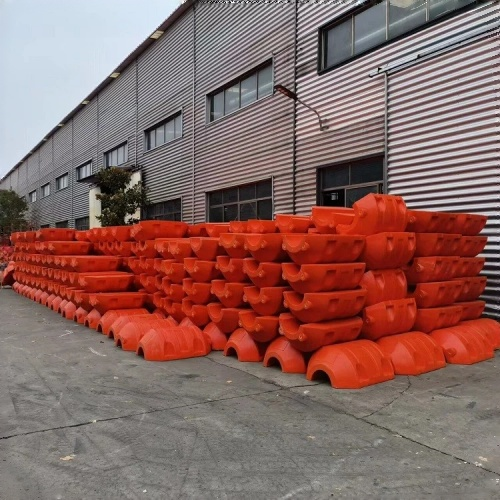
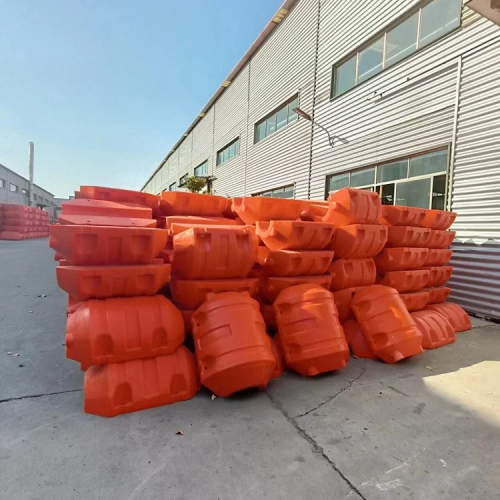
HDPE Provides Outstanding Weather Resistance
Most rotationally molded pipe floats are manufactured from high-density polyethylene (HDPE), a material well known for its resistance to corrosion, chemicals, and ultraviolet exposure.
Unlike steel, HDPE will not rust, and it does not require protective coatings or regular repainting. UV stabilizers are commonly added during manufacturing, allowing the floats to remain outdoors for years without becoming brittle or losing their mechanical strength.
Whether installed in freshwater reservoirs or offshore construction projects, HDPE pipe floats are designed to perform reliably in harsh environments.
Flexible Designs for Different Project Requirements
Every pipeline project is different. Pipe diameter, buoyancy requirements, installation methods, and environmental conditions can all vary from one job site to another.
Rotational molding offers manufacturers the flexibility to produce pipe floats in a wide variety of sizes, colors, and buoyancy ratings without major tooling modifications. It also allows practical features to be incorporated directly into the product, including reinforced ribs, cable channels, mounting points, identification markings, and customized fastening systems.
This level of design flexibility makes it much easier to provide solutions that match specific customer requirements instead of relying on standard products alone.
Reduced Maintenance Helps Lower Operating Costs
Maintenance is another area where rotationally molded pipe floats offer a clear advantage.
Because there are no welded seams to inspect and HDPE naturally resists corrosion, routine maintenance is usually limited to periodic visual inspections. There is no need for rust treatment, repainting, or frequent structural repairs.
For contractors managing large floating pipeline systems, reducing maintenance time can translate directly into lower operating costs and less equipment downtime over the life of the project.
Built for Long-Term Industrial Use
One of the reasons rotational molding continues to gain popularity is its ability to combine durability with long service life. The seamless structure, uniform wall thickness, and corrosion-resistant material work together to create a product capable of performing reliably in challenging industrial environments.
Although the initial manufacturing process differs from other plastic molding methods, the long-term benefits often outweigh the difference. Longer service life, lower maintenance requirements, and dependable performance all contribute to better overall value.
Conclusion
Selecting the right pipe float involves more than simply choosing the right material. The manufacturing process also plays a major role in determining how well the product performs over time.
Rotationally molded HDPE pipe floats have earned their reputation because they offer a combination of strength, durability, corrosion resistance, and design flexibility that is difficult to achieve with other production methods. For dredging, mining, marine construction, and water transfer projects, they remain a reliable and cost-effective solution for supporting floating pipeline systems.