

As a supplier of HDPE Pipe Floats, I am often asked about the remarkable ability of these floats to withstand impacts. In this blog post, I will delve into the scientific principles and design features that enable HDPE Pipe Floats to endure various impacts, ensuring their reliability in different applications.
Understanding HDPE and Its Properties
High - Density Polyethylene (HDPE) is a thermoplastic polymer known for its exceptional strength - to - weight ratio. It is made up of long chains of ethylene monomers, which are densely packed. This dense molecular structure gives HDPE several advantageous properties that contribute to the float's impact resistance.
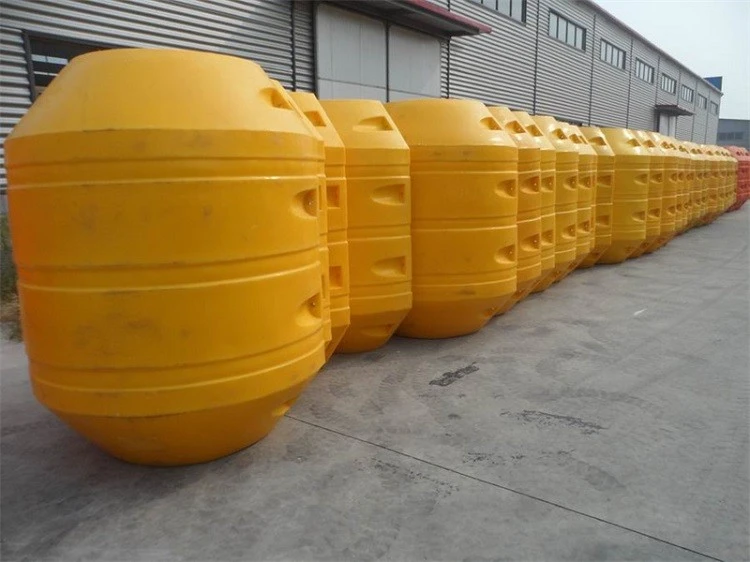

One of the key characteristics of HDPE is its high toughness. Toughness is the ability of a material to absorb energy and deform plastically without fracturing. When an HDPE Pipe Float is subjected to an impact, the long polymer chains can stretch and realign, dissipating the energy of the impact over a larger area. This prevents the sudden release of energy that could lead to cracks or breaks in the float.
HDPE also has excellent abrasion resistance. In marine or industrial environments, floats may come into contact with rough surfaces, such as rocks or the seabed. The abrasion - resistant nature of HDPE ensures that the outer surface of the float remains intact even after repeated rubbing or scraping, maintaining its structural integrity over time.
Design Features for Impact Resistance
In addition to the inherent properties of HDPE, the design of the pipe floats plays a crucial role in their ability to withstand impacts.
Wall Thickness
The wall thickness of an HDPE Pipe Float is carefully engineered. A thicker wall can provide more material to absorb the impact energy. However, it is a balance, as increasing the wall thickness too much can add unnecessary weight and cost. Our HDPE Pipe Floats are designed with an optimized wall thickness that provides sufficient strength while keeping the weight manageable. This allows the floats to be easily installed and transported without sacrificing impact resistance.
Shape and Structure
The shape of the float is another important factor. Most HDPE Pipe Floats have a cylindrical shape, which is inherently strong. The circular cross - section distributes the impact forces evenly around the circumference of the float. When an object hits the float, the force is spread out, reducing the stress concentration at any single point.
Some of our floats also have internal ribbing or a honeycomb - like structure. These internal structures add additional strength and stiffness to the float. They act as reinforcements, helping the float to maintain its shape and resist deformation during an impact.
Foam Filling
Many of our HDPE Pipe Floats are filled with foam, which provides several benefits for impact resistance.
Energy Absorption
The foam inside the float acts as a cushion. When an impact occurs, the foam compresses, absorbing a significant amount of the energy. This reduces the amount of force that is transferred to the HDPE shell of the float. The foam also helps to distribute the impact force more evenly throughout the float, further protecting the outer shell from damage.
Buoyancy and Stability
The foam filling not only enhances impact resistance but also contributes to the buoyancy and stability of the float. A stable float is less likely to be damaged by impacts because it is less likely to be tossed around or collide with other objects in a more violent manner. The foam helps to keep the float in an upright position, reducing the risk of impacts from unexpected angles.
Applications and Impact Scenarios
HDPE Pipe Floats are used in a wide range of applications, each with its own set of impact scenarios.
Marine Dredging
In marine dredging operations, Marine Dredging Pipe Float are used to support the dredging pipes. These floats are constantly exposed to impacts from waves, floating debris, and the movement of the dredging equipment. The high - impact resistance of our HDPE Pipe Floats ensures that they can withstand the harsh conditions of the marine environment, providing reliable support for the pipes over long periods of time.
Cable Floating
Dredging Cable Float are used to keep cables afloat in water. They may be subjected to impacts from boats, fishing equipment, or other underwater objects. The impact - resistant properties of HDPE ensure that the floats protect the cables from damage, maintaining the integrity of the cable system.
Testing and Quality Assurance
As a supplier, we are committed to ensuring the highest quality of our HDPE Pipe Float. We conduct a series of tests to evaluate the impact resistance of our floats.
Drop Tests
Drop tests are performed to simulate the impact that a float may experience during handling or installation. The floats are dropped from a specified height onto a hard surface, and the damage is carefully inspected. Our floats are designed to pass these drop tests without significant damage, ensuring that they can withstand real - world impacts.
Impact Resistance Tests
We also use specialized equipment to apply controlled impacts to the floats. These tests measure the energy absorption capacity and the maximum force that the float can withstand before failure. By continuously improving our manufacturing processes based on these test results, we ensure that our floats meet or exceed industry standards for impact resistance.
Conclusion
In conclusion, the ability of HDPE Pipe Floats to withstand impacts is a result of a combination of the inherent properties of HDPE, careful design features, and the use of foam filling. These factors work together to make our HDPE Pipe Floats reliable and durable in a variety of applications.
If you are in the market for high - quality, impact - resistant HDPE Pipe Floats, we invite you to contact us for more information and to discuss your specific requirements. Our team of experts is ready to assist you in finding the best solutions for your projects.
References
- Callister, W. D., & Rethwisch, D. G. (2011). Materials Science and Engineering: An Introduction. Wiley.
- Ashby, M. F. (2005). Materials Selection in Mechanical Design. Butterworth - Heinemann.