

Hey there! As a supplier of Pipe Floaters, I've been in the business long enough to know that accurately measuring the buoyancy of these floaters is super important. Whether you're into dredging, mining tailings, or other related industries, getting the buoyancy right can make or break your project. So, let's dive into how you can measure the buoyancy of a Pipe Floater accurately.
Understanding Buoyancy Basics
First things first, let's quickly go over what buoyancy is. Buoyancy is the upward force exerted by a fluid (like water) that opposes the weight of an immersed object. In the case of our Pipe Floaters, this upward force keeps the pipes afloat. Archimedes' principle states that the buoyant force acting on an object submerged in a fluid is equal to the weight of the fluid displaced by the object.
So, to measure the buoyancy of a Pipe Floater, we need to figure out how much fluid it displaces. Sounds simple, right? Well, there are a few steps and factors to consider.
Step 1: Gather Your Tools
Before you start measuring, you'll need some tools. You'll need a scale to weigh the Pipe Floater, a container large enough to fully submerge the floater, and a way to measure the volume of water displaced. A graduated cylinder or a large measuring container with volume markings will work great.
Step 2: Weigh the Pipe Floater
The first thing you want to do is weigh the Pipe Floater on the scale. Make sure the scale is calibrated correctly to get an accurate measurement. Note down the weight of the floater in kilograms or pounds, depending on your preference. This weight is important because it will be used later to calculate the buoyant force.
Step 3: Measure the Volume of Water Displaced
Now, fill the container with water up to a certain level. Mark this level on the container so you can easily see the change in water level later. Carefully lower the Pipe Floater into the water, making sure it's fully submerged. As the floater displaces water, the water level in the container will rise.
Measure the new water level and calculate the difference between the initial and final water levels. This difference represents the volume of water displaced by the Pipe Floater. You can use the markings on the container or transfer the displaced water to a graduated cylinder for a more accurate measurement.
Step 4: Calculate the Buoyant Force
Once you have the volume of water displaced, you can calculate the buoyant force. The density of water is approximately 1000 kg/m³ or 62.4 lb/ft³. To calculate the buoyant force, you multiply the volume of water displaced (in cubic meters or cubic feet) by the density of water and the acceleration due to gravity (9.8 m/s² or 32.2 ft/s²).
The formula for buoyant force is:
[F_b = \rho \times V \times g]
Where:

- (F_b) is the buoyant force
- (\rho) is the density of the fluid (water in this case)
- (V) is the volume of fluid displaced
- (g) is the acceleration due to gravity
Let's say you measured the volume of water displaced by the Pipe Floater to be 0.1 m³. Using the density of water ((\rho = 1000 kg/m³)) and the acceleration due to gravity ((g = 9.8 m/s²)), the buoyant force would be:
[F_b = 1000 kg/m³ \times 0.1 m³ \times 9.8 m/s² = 980 N]
Factors Affecting Buoyancy
Now, it's important to note that there are a few factors that can affect the buoyancy of a Pipe Floater. One of the main factors is the material of the floater. Different materials have different densities, which can affect how much water they displace and, therefore, their buoyancy.
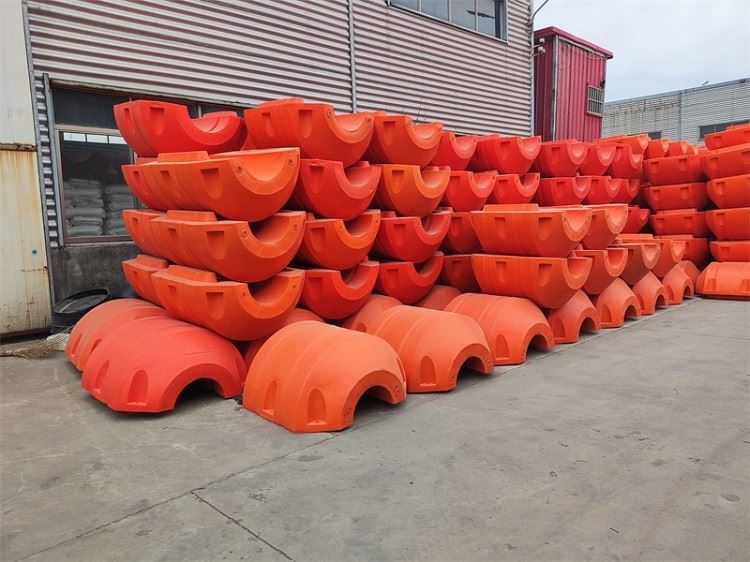
For example, our Plastic Dredging Pipe Float is made of high-quality plastic that has a relatively low density, making it highly buoyant. On the other hand, a floater made of a denser material may not displace as much water and may have a lower buoyancy.
Another factor to consider is the shape of the Pipe Floater. A floater with a larger surface area will displace more water and have a higher buoyancy than a floater with a smaller surface area. Additionally, the design of the floater, such as the presence of air chambers or foam filling, can also affect its buoyancy.
Testing in Real-World Conditions
While calculating the buoyancy using the method described above gives you a good estimate, it's always a good idea to test the Pipe Floater in real-world conditions. This can help you account for any factors that may not have been considered in the calculations, such as the presence of waves, currents, or other environmental factors.
To test the floater in real-world conditions, you can place it in a body of water and observe how it behaves. Make sure the floater is properly attached to the pipe and that the pipe is filled with the appropriate fluid. Monitor the position of the pipe and the floater over time to ensure that the floater is providing enough buoyancy to keep the pipe afloat.
Importance of Accurate Buoyancy Measurement
Accurately measuring the buoyancy of a Pipe Floater is crucial for several reasons. First and foremost, it ensures the safety and stability of your pipes. If the floater does not provide enough buoyancy, the pipes may sink, leading to damage or even failure of the system. On the other hand, if the floater provides too much buoyancy, it may cause the pipes to float too high, which can also lead to problems.
In addition to safety, accurate buoyancy measurement can also help you optimize the performance of your system. By choosing the right Pipe Floater with the appropriate buoyancy, you can reduce the energy required to move the pipes and improve the overall efficiency of your operation.
Conclusion
So, there you have it! Measuring the buoyancy of a Pipe Floater accurately is not as complicated as it may seem. By following the steps outlined above and considering the factors that can affect buoyancy, you can ensure that your Pipe Floaters provide the right amount of buoyancy for your needs.
If you're in the market for high-quality Pipe Floaters, look no further! We offer a wide range of Pipe Floaters and Pipe Float For Mining Tailings that are designed to provide excellent buoyancy and durability. Contact us today to discuss your requirements and get a quote.
References
- Archimedes' Principle: A fundamental law of physics that describes the buoyant force acting on an object submerged in a fluid.
- Fluid Mechanics: The study of fluids and their behavior, including the principles of buoyancy.