

Hey there! As a supplier of rotomoulded products, I've often gotten questions about how our stuff differs from injection - moulded products. So, I thought I'd sit down and lay out all the differences in a way that's easy to understand.
Let's start with the basics. Rotational moulding, or rotomoulding for short, is a manufacturing process where you put a powdered plastic resin into a mold. Then, the mold gets heated and rotated slowly on two perpendicular axes. The rotation makes the plastic coat the inside of the mold evenly as it melts. Once it cools down, you're left with a finished product. Injection molding, on the other hand, is when you melt plastic pellets and inject them at high pressure into a mold cavity. The plastic then cools and solidifies to form the product.
Design Flexibility
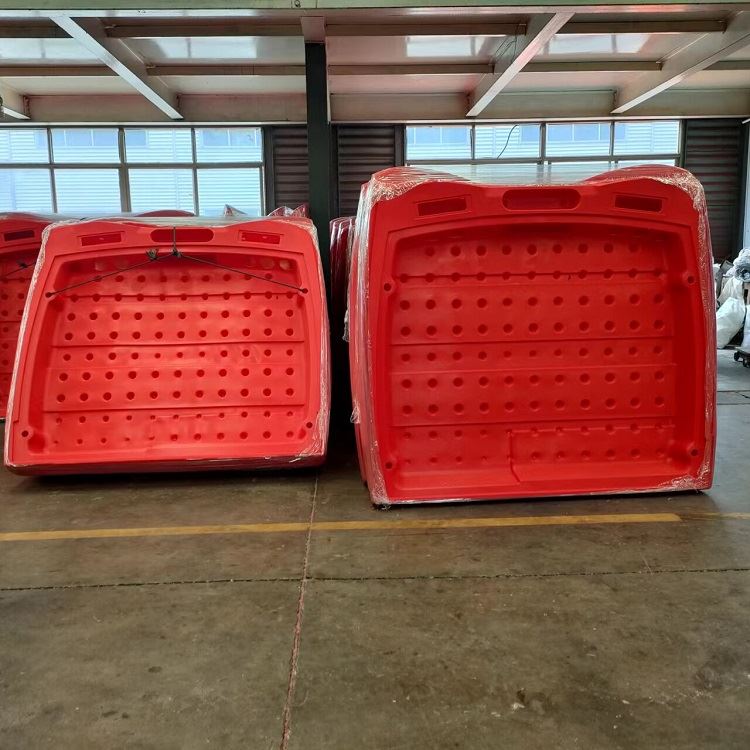
One of the biggest perks of rotomoulded products is the design flexibility. With rotomoulding, you can create products with complex shapes and uniform wall thickness. You don't have to worry about issues like undercuts or sharp corners as much as you would with injection molding. For example, our Rotational Moulding Farm Machinery Ceiling has a unique design that wraps around the machinery to provide protection. The rotomoulding process allows us to make it seamless and well - fitting, giving it better durability and functionality.
Injection molding has some limitations when it comes to design. High - pressure injection can cause problems with the flow of plastic, especially in intricate designs. So, if you want a product with a real funky shape, rotomoulding is probably the way to go.
Cost - Effectiveness
When it comes to cost, it really depends on the volume of production. For small to medium - scale production, rotomoulding is often more cost - effective. The molds used in rotomoulding are generally less expensive to make than injection molds. They're usually made from materials like aluminum, which is cheaper and easier to work with compared to the steel molds used in injection molding.
Let's say you're a startup looking to produce a small batch of custom containers. The cost of making an injection mold for that could eat up a big chunk of your budget. But with rotomoulding, you can get a more affordable mold and still produce high - quality containers, like our Aquaculture Leech Container. This container is made with a reasonable cost, making it accessible for small aquaculture businesses.
However, if you're planning to mass - produce a simple, standardized product, injection molding might be more cost - effective in the long run. The higher initial cost of the injection mold can be offset by the lower per - unit cost when producing large quantities.
Wall Thickness and Strength
Rotomoulded products typically have a more uniform wall thickness. The rotating process ensures that the plastic spreads evenly throughout the mold. This uniform thickness contributes to the overall strength of the product. Our Plastic Round Floats for Special Use are a great example. The consistent wall thickness gives them the strength to float on water and withstand external forces without buckling.
In injection molding, the wall thickness can vary, especially in complex parts. The high - pressure injection can cause the plastic to flow unevenly, leading to thin or thick spots. This uneven wall thickness can weaken the structure of the product and make it more prone to damage.
Material Selection
Both rotomoulding and injection molding can use a wide range of plastics. But rotomoulding generally has more flexibility in material selection. You can use materials like polyethylene, polypropylene, and other specialty plastics. Different grades of these materials can be chosen based on the specific needs of the product, such as its durability, chemical resistance, or UV resistance.
Injection molding also has a good selection of materials, but some plastics are better suited for the high - pressure injection process. For example, some thermoplastics that are very viscous might not flow well in an injection mold, while they can work just fine in a rotomoulding setup.
Production Speed
When it comes to speed, injection molding has the upper hand. Since it uses high - pressure injection, the plastic fills the mold quickly, and the cycle time can be relatively short. This makes it ideal for mass - production scenarios where you need to churn out a large number of products in a short time.
Rotomoulding, on the other hand, is a slower process. The heating and cooling cycles take longer, and the rotation of the mold is a relatively slow operation. But this slower process is what allows for the creation of high - quality, well - formed products with uniform wall thickness.
Surface Finish
The surface finish of rotomoulded and injection - moulded products can be different. Rotomoulded products often have a smooth, matte - like finish. This finish can give a more natural and durable look. It's also less likely to show scratches or scuffs compared to a glossy finish.
Injection - moulded products can have a very smooth and shiny finish, especially when the mold is highly polished. However, this shiny finish can also make scratches and imperfections more visible.
Environmental Impact
From an environmental perspective, rotomoulding can be a great option. The process generates less waste since the plastic powder is fully used in the mold, and there are no runners or sprue (the channels through which plastic flows in injection molding) that need to be discarded. Also, many rotomoulded products are made from recyclable plastics, which is a plus for those looking to be more eco - friendly.
Injection molding can produce more waste in the form of runners and sprue. But many injection - molding companies have processes in place to recycle this waste.
Applications
Rotomoulded products are used in a wide variety of industries. They're popular in agriculture, like our farm machinery ceiling. They're also used in aquaculture for things like leech containers and floating platforms. Additionally, rotomoulding is great for making playground equipment, storage tanks, and even some automotive parts.
Injection - moulded products are commonly found in the electronics industry for making casings and components. They're also used in the medical field for making syringes, vials, and other disposable items.

If you're in the market for high - quality rotomoulded products, I'd love to talk to you. Whether you need a custom - designed product or a standard item, we've got the expertise and experience to meet your needs. Contact us to start a discussion about your requirements and see how our rotomoulded products can fit into your business.
References
- "Manufacturing Processes for Engineering Materials" by Serope Kalpakjian and Steven R. Schmid
- Industry reports on rotational molding and injection molding technologies