

Hey there! As a supplier of HDPE straight pipes, I often get asked about the flow capacity of these pipes. So, I thought I'd write a blog post to share some insights on this topic.
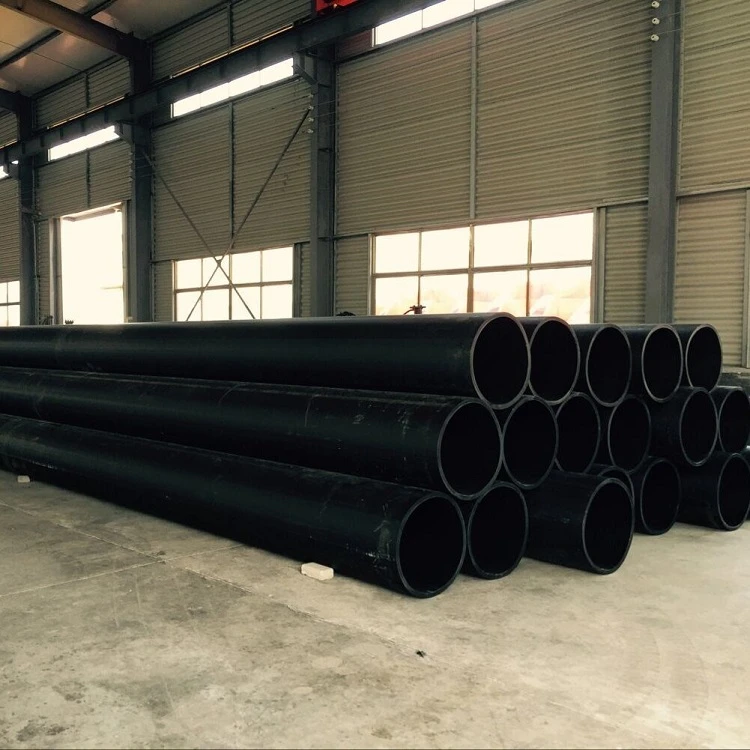
Let's start by understanding what HDPE straight pipes are. HDPE stands for High - Density Polyethylene. These pipes are known for their durability, flexibility, and resistance to corrosion. They're used in a wide range of applications, from water supply systems to industrial drainage and even dredging projects.
Now, when it comes to the flow capacity of HDPE straight pipes, it's not a one - size - fits - all answer. There are several factors that can affect how much fluid a pipe can carry.
Factors Affecting Flow Capacity
Pipe Diameter
One of the most significant factors is the diameter of the pipe. It's pretty intuitive, right? A larger diameter pipe can generally carry more fluid than a smaller one. For example, if you have a 6 - inch diameter HDPE straight pipe and a 12 - inch diameter one, the 12 - inch pipe will have a much higher flow capacity. This is because the cross - sectional area of the pipe is larger, allowing more fluid to pass through at a given time.
Pipe Length
The length of the pipe also plays a role. Longer pipes can cause more friction, which reduces the flow rate. As the fluid moves through the pipe, it rubs against the inner walls, and this friction slows it down. So, if you have a very long HDPE straight pipe, you might need to account for this loss in flow capacity.
Fluid Viscosity
The type of fluid flowing through the pipe matters too. Viscosity is a measure of a fluid's resistance to flow. For instance, water has a relatively low viscosity, so it can flow through an HDPE straight pipe more easily compared to a thick oil or a slurry. If you're dealing with a high - viscosity fluid, you might need a larger diameter pipe or a higher pressure to maintain an acceptable flow rate.
Pipe Wall Roughness
The inner surface of the HDPE straight pipe can also impact flow capacity. HDPE pipes are known for their smooth inner walls, which is great for fluid flow. A smooth surface reduces friction, allowing the fluid to move more freely. In contrast, pipes with rough inner walls can cause more turbulence and slow down the flow.
Calculating Flow Capacity
To calculate the flow capacity of an HDPE straight pipe, we often use the Hazen - Williams equation. This equation is widely used in the industry and takes into account the pipe diameter, length, and the roughness coefficient of the pipe material. The formula is:
[Q = 0.284 C D^{2.63} \left(\frac{h_f}{L}\right)^{0.54}]
where:
- (Q) is the flow rate (in cubic feet per second)
- (C) is the Hazen - Williams coefficient (for HDPE pipes, (C) is usually around 150 - 160, indicating a smooth pipe)
- (D) is the internal diameter of the pipe (in feet)
- (h_f) is the head loss (in feet)
- (L) is the length of the pipe (in feet)
Let's say you have a 10 - inch (0.833 feet) diameter HDPE straight pipe that's 100 feet long, and the head loss is 5 feet. Using a Hazen - Williams coefficient of 150, you can plug these values into the equation to calculate the flow rate.
[Q = 0.284\times150\times(0.833)^{2.63}\times\left(\frac{5}{100}\right)^{0.54}]

This calculation will give you an estimate of how much fluid the pipe can carry under these specific conditions.
Applications and Flow Capacity Requirements
Different applications have different flow capacity requirements. For example, in a water supply system for a small residential area, you might need a relatively small - diameter HDPE straight pipe with a lower flow capacity. But for a large industrial complex or a municipal water treatment plant, you'll likely need much larger pipes with high flow capacities.
In dredging projects, the flow capacity of HDPE straight pipes is crucial. The pipes need to be able to carry a large volume of water and sediment mixture. That's why we offer Black Dredging HDPE Straight Pipe. These pipes are designed to handle the harsh conditions of dredging, with a high flow capacity to ensure efficient operation.
If you're working in an outdoor environment where the pipes are exposed to sunlight, our UV Resistance HDPE Straight Pipe is a great option. It can withstand the damaging effects of UV rays while maintaining its flow capacity over time.
And for those who need a dredging solution without the hassle of flanges, we have Dredging HDPE Pipe without Flange. These pipes are easy to install and can still provide a reliable flow capacity for your dredging needs.
Importance of Accurate Flow Capacity Estimation
Getting the flow capacity right is crucial for any project. If you underestimate the flow capacity, you might end up with a system that can't handle the required fluid volume. This can lead to backups, reduced efficiency, and even system failures. On the other hand, if you overestimate, you might end up spending more money on larger pipes than you actually need.
As a supplier of HDPE straight pipes, we can help you determine the right pipe size and configuration for your specific application. We have a team of experts who can take into account all the factors mentioned above and provide you with a solution that meets your flow capacity requirements.
Contact for Procurement
If you're in the market for HDPE straight pipes and need to ensure the right flow capacity for your project, don't hesitate to reach out. We're here to assist you in choosing the best pipes and answering any questions you might have. Whether it's for a small - scale project or a large industrial application, we've got you covered.
References
- "Pipe Flow Handbook" by Crane Co.
- "Fluid Mechanics" by Frank M. White